The Log Bedroom
|
|
|
Logmania
Lots of Work
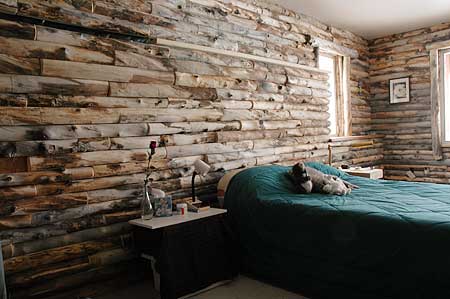
Linda wanted a log cabin. But it was not in our budget. So I promised I would cover the bedroom walls in dead aspen. It was a labor of love.
The bedrooms are downstairs in this cabin. Set on a slight slope, the cabin has a "sunlight basement," with two bedrooms and a bathroom. All three rooms have a view of the fourteener peaks to our west.
This room is very cosy, insulated by the earth, by a lot of concrete, by foam concrete forms, by regular insulation in the framed parts, and lastly by the layer of aspen tiles.
|
|
Gathering Logs
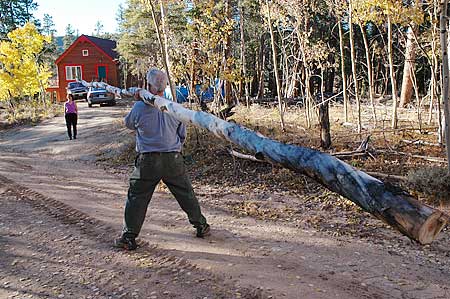
It took two years to cover the walls. The bulk of the work consisted of making the aspen "tiles." The first step, repeated over and over, was to gather the trees. I did most of it by myself, but on this particular day Bruce Parker helped me harvest a few dead aspens. I cut them with a buck saw and carry them back to the cabin.
I often cut the trees in half to make it easier to handle. On this day we brought in the whole trees.
|
|
Milling the Logs
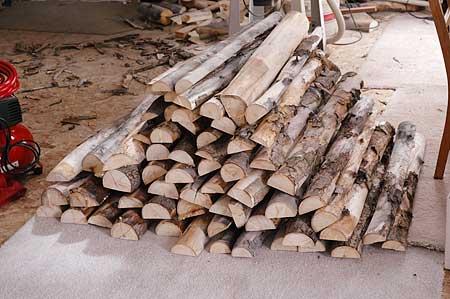
I cut the tree into 36" lengths, which I then slice those lengths in half.
I have a series of 36" wood templates that are 3", 3.5", 4" and 4.5" wide. I lay these templates on the flat side of the half-logs and pencil in the cut lines which will make these half-logs into tiles that can be applied in strips of consistent width. I wrote their width number on the flat side for easy sorting and inventory.
To cut these logs I used a Delta 28-276, 14" bandsaw. The blade is important. I used a Highland Woodworking "Wood Slicer." It is described as a " super sharp thin-kerf precision resawing blade."
|
|
Milling the Logs
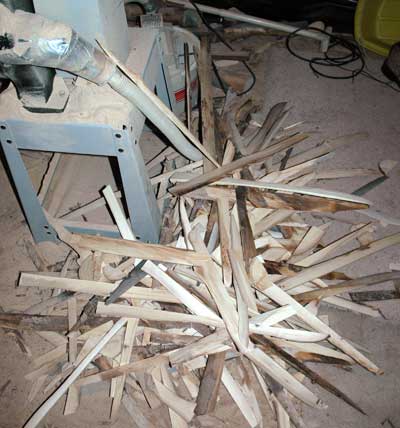
This picture of the trim waste gives a hint of how much work there is in making these aspen tiles.
After cutting the tiles into rectangles, my last step was to soften the end cuts with the belt sander.
I then carried the aspen tiles to bedroom for application.
|
|
Application
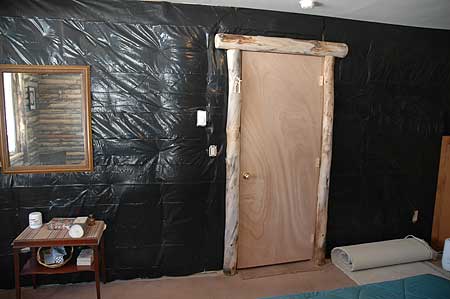
Before I began applying the tiles, I trimmed the doors and windows with specially-chosen and prepared trees. This photo shows the black-plastic ambience of the room before aspens covered the walls.
|
|
Application
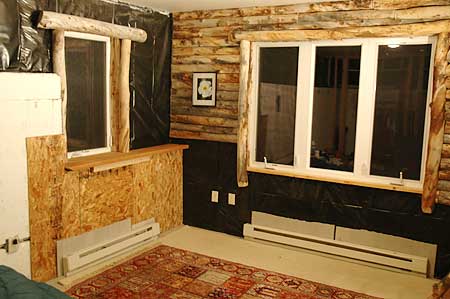
The southeast corner presented a variety of challenges.
I had to prepare the foundation walls with a surface of scrap particle board; those boards are screwed into the plastic heads in the foam panels remaining from the concrete forms. the aspen tiles are nailed into the particle board.
Above the shelves, the walls are standard frame construction and I nailed the tiles into the studs.
|
|
Application
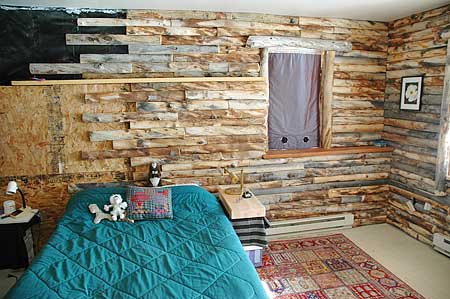
I applied the tiles using both a pneumatic nailer and regular nails. I started at the top and worked down in rows.
You can see two shelves in this photo. Below the small window (with its solar curtain in place) is a stained and varnished shelf. Higher and to the left is an unfinished shelf. Both are made of recycled 2x6 scrap. They sit on top of the foundation walls.
Recycling note: the oriental rug is from my city dumpster. What a find.
The carpet on the floor is scrap from a carpet-company dumpster in my city neighborhood. Until we decide what to do in the stairwell and bedrooms, the scraps are performing admirably.
|
|
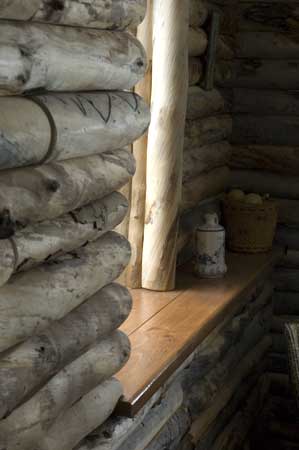
Detail
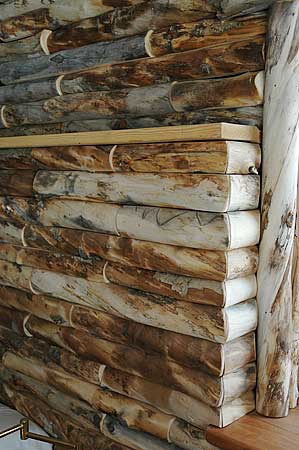
You can see the projection of the concrete wall. I had to fit a complex corner by the little window.
The spruce-scrap shelf is still unfinished.
|
|
Shelf
The windows' shelves are made of 2x6 spruce framing scraps found in the dumpsters of construction projects in my city neighborhood. They are finished with brown UV Guard and Varathan varnish.
|
|
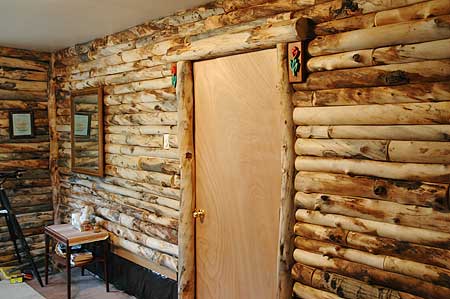
Details
This is the interior wall. In the corner you can see a vertical log. This is where I began the log tiling. I was making up my way on the log-covered room, and abandoned this style of corner for a simple 45 degree fit in all the other corners.
After the room was finished, I came back and chinked any spaces between the logs with thin strips of aspen.
|
|
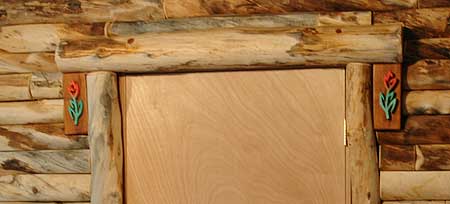
Detail
Lintel Glyphs
 I made two aspen blocks and then cut glyphs in the shape of paintbrush flowers. I made two aspen blocks and then cut glyphs in the shape of paintbrush flowers.
I airbrushed the paintbrushes with thinned-out acrylic paint. The aspen blocks are stained with brown UVguard. Assembled, the glyph blocks are varnished and set under the overhang of the lintel.
|
|
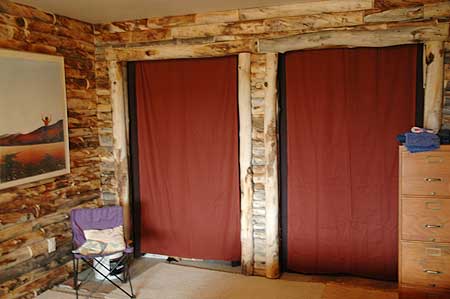
Closet Doors
Improvisation
Many choices and purchases were deferred in our cabin project. The floors of the bedrooms, for example, are covered in carpet scraps the I obtain from the dumpster of a local carpet business. The closet doors may receive actual doors at some point in time. In the meantime, I made some quick curtains using cloth from a collection of fabric remnants contributed by a neighbor who was cleaning house.
The red fabric was not quite wide enough, so I added strips of black cloth at the ends. The curtains are stapled to a strip of wood. This bar is nailed to the inner wall just under the cieling, giving the curtain an easy action when you push it to the side to use the closet.
|
 |
Afternoon Light
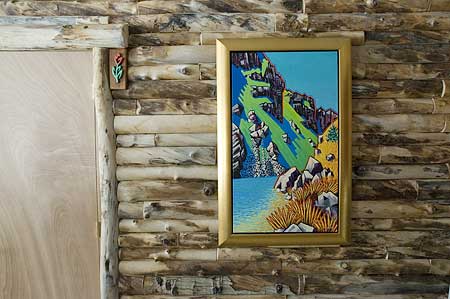
The southwestern windows flood this room with light in the late afternoon. The oil painting by John Boak is titled "Iceberg Lake."
|